Shankara Jayanti in Australia: How the Indian Community Celebrates
Every year, the Indian diaspora in Australia comes together with great devotion to celebrate Shankara Jayanti, the birth anniversary of the revered 8th-century philosopher and spiritual leader, Adi Shankaracharya.
This auspicious occasion honours his profound teachings on Advaita Vedanta, non-dualism, and the pursuit of ultimate knowledge. For the Indian community, Shankara Jayanti serves as a vibrant bridge between ancient Indian wisdom and their lives in multicultural Australia.
Who Was Adi Shankaracharya and Why Does This Day Matter
Adi Shankaracharya was an Indian philosopher and theologian who consolidated the doctrine of Advaita Vedanta. His core teaching is that the individual self and universal consciousness (Brahman) are not separate things.
He travelled across India, debated scholars, established four mathas (monasteries) at the four corners of the subcontinent, and wrote commentaries on the Upanishads, the Bhagavad Gita, and the Brahma Sutras.
According to tradition, he accomplished all of this within a remarkably short life, widely believed to have ended in his early thirties.
Shankara Jayanti falls on the fifth day (Panchami) of the bright fortnight in the Hindu month of Vaishakha, typically landing in April or May on the Gregorian calendar. Confirm against drikpanchang.com or a similar authoritative source before going live.
The Weekday Problem Nobody Talks About
Shankara Jayanti rarely falls on a weekend.
Because it follows the Hindu lunar calendar, the date shifts every year. Most working-age Indians in Australia, employed in IT, healthcare, finance, and engineering, simply cannot take a day off mid-week without planning well in advance. And unlike Diwali, which has grown visible enough for many workplaces to acknowledge it informally, Shankara Jayanti is not on any Australian HR calendar.
Other April observances like Vaisakhi face similar challenges.
Read more: Vaisakhi Celebrations in Australia: Best Events, Cities & What to Expect.
Live tip
If the date falls on a workday, check whether your workplace supports cultural leave under its diversity policy. Some Australian workplaces, particularly in the public sector, allow personal leave to be used for cultural or religious observance. Check your enterprise agreement or ask HR directly about your options.
The practical workaround most community groups have adopted is to schedule the main public program on the closest weekend, while those who observe strictly still do the morning abhisheka at home or at a local temple before work.
Where Celebrations Actually Happen Across Australia
In Sydney, the Sri Mandir at Parramatta and the Shirdi Sai Baba Temple in Pendle Hill both hold special puja sessions and devotional programs. The Vedanta Society of New South Wales, though small in membership, runs discussion evenings around this time focused on Advaita philosophy.
In Melbourne, the BAPS Swaminarayan Temple in Campbellfield and various Smarta community groups in the southeastern suburbs organise early morning abhisheka and evening discourses. The Shiva Vishnu Temple in Carrum Downs , one of Australia’s oldest and largest Hindu temples, is a reliable venue for observances like this.
In Brisbane and Perth, celebrations are more intimate, usually organised by cultural associations or community WhatsApp groups rather than large temple committees. Don’t underestimate these smaller gatherings. They are often where the real philosophical conversation actually happens.
How to find a Shankara Jayanti event near you
There is no single national directory for Shankara Jayanti events. Your best starting points are the Hindu Council of Australia at hinducouncil.com.au , local temple Facebook pages, and community groups like “Indians in Melbourne” or “Sydney Indian Community” on Facebook. If you are outside a major city, call the nearest temple directly. Regional communities in Canberra, Wollongong, and Geelong often organise their own gatherings, so it is worth reaching out directly.
What the Day Actually Looks Like
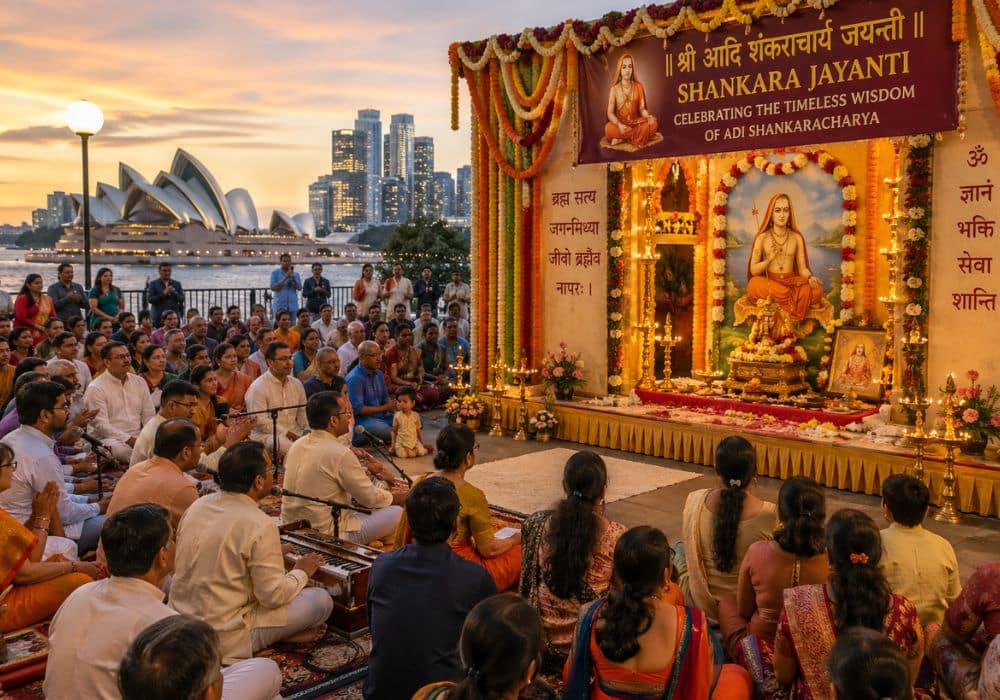
The morning begins with a special abhisheka of Shankaracharya’s image or a Shivalinga, accompanied by Vedic chanting. Temples with a pandit on staff, like the Shiva Vishnu Temple in Carrum Downs, typically lead more elaborate rituals.
Later in the day, there is usually a pravachan (discourse) or lecture. These range from a temple priest explaining Shankaracharya’s life story to a more scholarly talk on Advaita Vedanta, delivered in English, Tamil, Telugu, Kannada, or Malayalam, depending on the congregation.
Evening programs often include bhajans, arati, and a shared meal. Sattvic food is the norm, meaning no meat, no onion, no garlic.
This time of year is spiritually significant across many Indian traditions. If your family observes other April festivals too, see our guide to the Best Solar New Year Celebrations in Australia for Indian Communities in 2026.
The Generational Disconnect That Community Groups Are Actively Trying to Fix
The first wave of Indian migrants, many of whom arrived under the skilled migration stream from the 1990s onward, carries a direct cultural memory of how this day was observed back home. Especially in Kerala, Karnataka, and Tamil Nadu, where Shankaracharya’s influence runs deepest.
For parents, the bridge starts not with rituals but with Shankaracharya’s central question: ‘Who am I?’ Framing it as a philosophical puzzle rather than a religious obligation tends to land better with teenagers.
Smart community groups, including some Chinmaya Mission branches in Sydney and Melbourne, now offer English-language Vedanta sessions before main programs. Many have shifted from rigid lectures to engaging storytelling, helping second-generation Indians connect with their heritage in a personal and relevant way.
A Note on Community Safety
In early 2023, multiple Hindu temples in Melbourne were vandalised. For a community already navigating visibility and belonging in a country that does not formally recognise its major festivals, this was a real blow.
It is worth knowing before you attend a temple event that the Hindu Council of Australia actively liaises with state police and local government on community safety. Major temple events in Sydney and Melbourne typically have volunteer security arrangements in place.
Safety tip
If you are attending a smaller or less-known community gathering for Shankara Jayanti, let someone outside the event know where you are going. Not because danger is likely, but because small temple gatherings in suburban locations sometimes lack proper signage, parking arrangements, or onsite safety volunteers. A quick text to a friend with the address is sensible, not paranoid.
How to Observe Shankara Jayanti at Home
Not everyone lives near the temple. Moreover, on a weekday, getting to Carrum Downs from the CBD before work is not realistic for most people.
Many families set up a small space with a picture of Adi Shankaracharya, light a diya, and chant or listen to one of his own compositions. The Kanakadhara Stotram and the Dakshinamurthy Stotram are both available on YouTube with translations.
Shankara Jayanti will not show up in your Google Calendar. Your Australian-born colleagues probably will not know about it. But if Shankaracharya’s core idea genuinely interests you, the idea that what you are searching for is not separate from you, this is one of the more accessible entry points into Vedanta that the Indian diaspora in Australia has created.


Oscar Mike
Oscar Mike is a professional content writer and passionate traveler with more than 8 years of experience in crafting engaging travel content. He enjoys sharing his travel experiences, useful tips, and destination guides to inspire others to explore the world.
When he’s not writing, you’ll find him playing with his beloved cats and kittens.