Qantas Check-In Policy: Everything Every Passenger Needs to Know Before They Get to the Gate
You book your flights, lock in your hotel, and pack your bags. Then you arrive at the airport and realise you are unsure about the check-in rules. Can you still check in online? Has the bag drop already closed? Why can’t you use your power bank at the gate? These questions catch many travellers off guard, but they are easy to avoid with the right information.
Qantas has a detailed check-in process, and a few parts have changed in recent times. If you have not reviewed the latest rules, you could run into delays at the airport. Here is a clear and simple guide to help you get through check-in without stress.
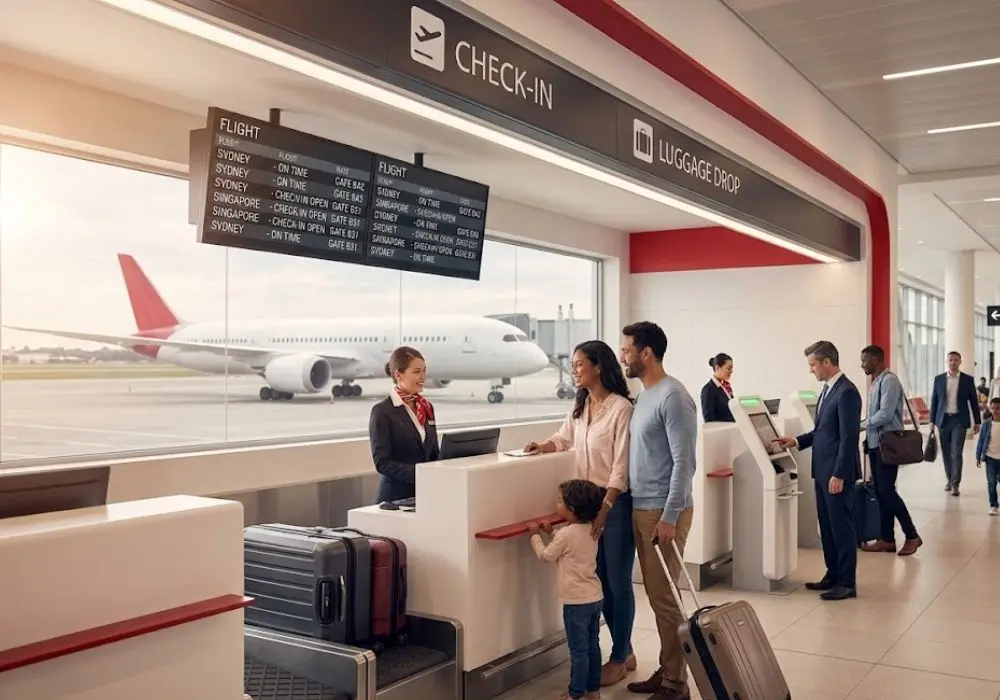
Online Check-In: The 24-Hour Window and What You Can Actually Do With It
Qantas opens online check-in 24 hours before departure and closes it 30 minutes before departure for domestic flights. For international flights, online check-in closes 90 minutes before departure.
You can check in through the Qantas website or through the Qantas App. Both work well, and the app gives you real-time gate and departure updates on top of your boarding pass.
During check-in, you can select or change your seat and access your digital boarding pass, which can be added to your Apple or Google Wallet. You can also check in a travelling companion on the same flight and in the same cabin, even if they’re on a separate booking, which is a genuinely useful feature that a lot of people don’t know about.
Who cannot Check In Online?
Some passengers have to head to the counter regardless of how organised they are. Unaccompanied minors must see a customer service agent at least one hour before domestic departures and at least two hours before international flights. Passengers needing mobility aid assistance need to check in at the airport at least 60 minutes before domestic departures, and at least two hours before international flights.
If you’re travelling with a pet, carrying medical equipment, or part of a large group booking, the counter is your starting point. If any of these apply to you, build in extra time at the airport.
The Check-In Deadlines: Domestic vs International
Check-in opens 24 hours before departure and closes 30 minutes before departure for Australian domestic flights, and two hours before departure for international flights.
For domestic bag drop, if you’ve already checked in via the app or online and have a Q Bag Tag, you can head straight to automated bag drop or the bag drop counter at least 30 minutes before departure.
For international travel, passengers who have completed online or mobile check-in can go directly to a dedicated Online Check-In counter at least 90 minutes before their flight. If that’s not available at their departure airport, they should head to the regular check-in desk.
A practical note: arriving two hours before an international Qantas flight is a reasonable baseline. But during school holidays, peak periods like Lunar New Year, or at busy hubs like Sydney’s T1 International, give yourself closer to three hours. The deadlines are firm, and Qantas staff cannot hold planes for late arrivals.
Kiosks and Bag Tags: How the Domestic System Actually Works
This is one area where Qantas’s domestic setup is genuinely efficient, once you understand how the pieces fit together.
If you’re departing from an Australian domestic terminal, once you’ve checked in through the app or online, proceed to one of the kiosks to print your bag tags. After attaching the bag tag, drop your bag at the bag drop counter.
At airports without kiosks, you go directly to the bag drop counter. The Qantas App handles most of this smoothly, including showing you which terminal you’re departing from and whether your specific airport has kiosk facilities.
Qantas-operated flights numbered QF1 to QF399 depart from an international terminal. QF400 and above depart from a domestic terminal. This is worth knowing if you are connecting between flights or picking someone up.
Priority Check-In for Frequent Flyers
At selected Australian domestic airports, priority check-in is available for Platinum One, Platinum, Gold, and Silver Frequent Flyers, Qantas Club members, oneworld Emerald, Sapphire, and Ruby members, and passengers travelling in Business.
If you’re a Qantas Frequent Flyer member, these priority lanes can cut significant time off your airport experience, particularly at Sydney, Melbourne, and Brisbane. Worth knowing if you fly Qantas regularly.
One important heads-up on Frequent Flyer membership for Australian residents: Qantas charges an AU$99.50 joining fee for Australian residents, though free membership options are widely available through partner promotions. If you’re not yet a member, it’s worth looking into the free join options before signing up directly.
Codeshare Flights: A Catch Many Passengers Miss
This one catches people out more than almost anything else.
If you’re travelling on a flight operated by another airline, you must check in with the operating carrier. For example, QF8405 from Melbourne to Dubai is operated by Emirates, so passengers check in with Emirates, not Qantas. Check-in times for partner airlines can vary, which may mean online check-in is not available for connecting flights.
If your booking confirmation shows a QF flight number but mentions a different aircraft or operator, check the operating carrier carefully before you try to check in via the Qantas app. Getting to the wrong counter wastes time you often don’t have.
Baggage at Check-In: Domestic and International Allowances
Qantas’s baggage rules differ quite a bit depending on your route and cabin class. Here’s the practical version.
Domestic Checked Baggage
On Australian domestic flights, Economy passengers can check one piece of luggage up to 23 kg. Premium Economy allows two pieces at 23 kg each. Business Class passengers get two pieces at 32 kg each.
No single piece of checked baggage can exceed 32 kg, regardless of total allowance or cabin class. If you’re carrying surfboards, bikes, or large sports equipment, you’ll want to confirm this with Qantas before arriving at the counter, not after.
Another important note to add, from 1 November 2025, Qantas capped the total checked baggage per passenger, including any additional pieces purchased, at 65 kg across all passengers.
International Checked Baggage
On most international Qantas routes, excluding North and South America, Economy passengers get a total weight allowance of 30 kg across as many bags as needed. Premium Economy and Business get 40 kg. First Class passengers receive 50 kg.
For flights to and from the Americas, the system switches to a piece-based allowance rather than total weight. Economy receives one piece up to 32 kg, Premium Economy two pieces, Business two pieces, and First Class three pieces on those routes.
You can check your specific allowance before you pack using the Qantas checked baggage allowance page. It’s worth doing this for routes where the rules differ from what you might expect.
Connecting Domestic and International on the Same Day
Here’s a useful rule that works in passengers’ favour. If your international and Australian domestic flights are on the same ticket, the international checked baggage allowances apply to the domestic flights as well. Where the international and domestic flights are on separate tickets. If the connection is on the same calendar day, the international allowance applies to both flights. Just make sure you present both tickets when checking in.
Carry-On Baggage: The Options and the Limits
Qantas has a relatively flexible carry-on policy, but the Dash 8 turboprops used on some regional routes are an exception.
On standard domestic and international services (excluding Dash 8 aircraft), passengers can choose between a single larger item, a wheeled suitcase up to 56 cm x 36 cm x 23 cm weighing no more than 10 kg or two smaller bags weighing 14 kg combined, or one smaller bag plus a non-rigid garment bag.
All passengers are also entitled to one personal item, such as a handbag or laptop bag, which should fit under the seat in front.
On Dash 8 aircraft operating regional routes, the allowance is reduced. Each piece of carry-on must not exceed the total dimensions of 105 cm and a weight of 7 kg.
The Civil Aviation Safety Authority (CASA) in Australia oversees aviation safety regulations, including what passengers can bring on board, and it’s the authority behind many of the lithium battery rules now in effect.
Power Banks: A New Rule That Every Passenger Needs to Know About
This is probably the biggest practical change for passengers since late 2025.
From 15 December 2025, the Qantas Group, covering Qantas, QantasLink, and Jetstar, implemented new restrictions on power banks across all flights.
The use of power banks on board is prohibited. Charging of power banks on board is also prohibited, including via in-seat power or USB ports.
Passengers may carry up to two power banks in their carry-on baggage, with each not exceeding a maximum capacity of 160 watt-hours. Power banks remain prohibited from checked baggage entirely.
The changes follow a comprehensive internal safety review and were developed in collaboration with industry partners, including Virgin Australia, the International Air Transport Association (IATA), and other oneworld carriers, and are informed by planned updates from the International Civil Aviation Organisation (ICAO) expected in 2026.
In practical terms, charge your devices before you get to the airport, and bring a USB-A to USB-C cable if your devices need it.
Keep your power banks in your seat pocket or under the seat in front during the flight. If that is not possible, a nearby overhead locker is acceptable, but keeping them within easy reach is the priority.
Baggage Fees: Pre-Purchase vs At the Airport
If you need extra baggage beyond your allowance, pre-purchasing online is considerably cheaper than paying at the airport.
For Australian domestic flights, pre-purchasing a bag online is considerably cheaper than paying at the airport. At the airport, an additional bag currently costs A$150, with a further A$60 heavy charge for bags over 23 kg. The rates for pre-purchasing online are lower and vary by route and fare, so check Manage Booking for your specific price
For flights to North and South America, the fee is A$300 per additional piece.
From 14 January 2026, the cost of additional baggage on Australian domestic flights increased. If you’re flying domestically with more than your standard allowance, check the current pricing on Qantas’s baggage pre-purchase page well before you travel.
Qantas in 2025: Where the Airline Actually Stands
At the 2025 Skytrax World Airline Awards, Qantas moved from 24th place in 2024 to 14th best airline in the world. It also took out the award for Best Airline in the Australia-Pacific region, ranking first across all cabin classes in that region.
The Skytrax World Airline Awards are based on passenger satisfaction surveys completed by travellers from more than 100 countries, covering more than 325 airlines.
A strong ranking doesn’t make check-in stress disappear. But it does suggest the product you’re paying for is worth the bit of prep it takes to navigate the policy correctly.