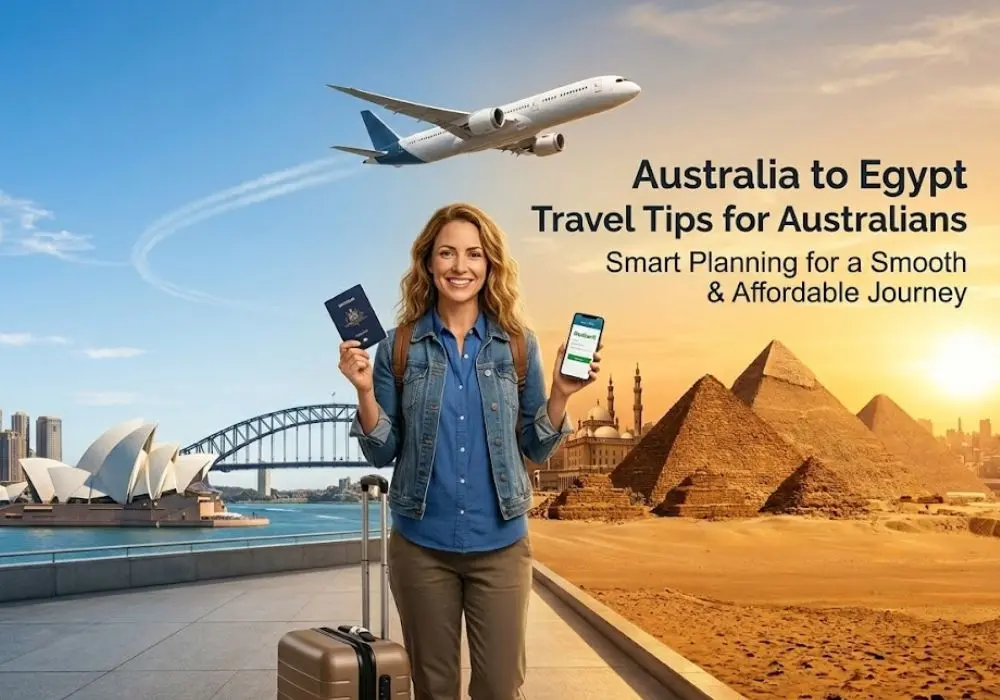
Australia to Egypt Travel Tips for Australians
Egypt rewards travellers who show up prepared and catches out those who don’t. From visa traps at Cairo Airport to ATM scams in tourist zones, the pitfalls are predictable and avoidable.
Here’s what Australians actually need to know before they go, based on how the country really works.
Getting Your Visa Right Before You Leave
If you’re travelling from Australia to Egypt, getting your visa sorted before departure can save time and hassle when you land. Australians don’t need to visit an Egyptian embassy.
You can apply online through Egypt’s official portal before you fly. It costs around USD $25 for a single entry and typically takes between 3 and 7 business days, so apply at least a week before you fly.
Visa on arrival is also available at Cairo Airport, though the fee rose to USD $30 in March 2026, another good reason to sort the e-visa before you leave.
Our Tip
We hear this one constantly. Travellers see social media posts claiming the e-visa “doesn’t work” and arrive at the airport without one, walking straight into the hands of airport touts charging double or more for help with paperwork. Use only Egypt’s official portal to apply, print your approval, and keep it with your passport. That’s it.
Flights From Australia and What to Expect on Arrival
There are no direct flights from Australia to Egypt. Every route connects through the Middle East, with Dubai (Emirates), Doha (Qatar Airways), and Abu Dhabi (Etihad) being the most common stopover cities. Total travel time from Sydney or Melbourne sits between 18 and 24 hours, including transit time.
Cairo is 8 to 9 hours behind Sydney, depending on whether Australia is in daylight saving time. Egypt does not observe daylight saving.
Our Tip
The moment you exit arrivals at Cairo International Airport, men in plain clothes will approach, some grabbing trolleys, others offering “VIP visa help” or claiming Uber is banned. None of it is true. We always advise travellers to walk past confidently, head to the official taxi rank, or open the Uber app on a local SIM before leaving the terminal. Have your accommodation address saved in English and Arabic.
What the Australian Government Says About Safety
Check Smartraveller before you go. As of 2026, Egypt sits at “Exercise a high degree of caution” overall. The North Sinai region is listed as “Do not travel,” and travel to other parts of the Sinai Peninsula outside Sharm el-Sheikh carries similar warnings.
Popular tourist areas, including Cairo, Luxor, Aswan, and the Red Sea coast, are generally safe for travellers who stay aware of their surroundings.
Register your trip on Smartraveller. It takes five minutes and means the Australian Government can reach you if something happens while you’re there.
Money, ATMs, and Where Australians Lose Out
The Egyptian Pound (EGP) has seen significant devaluation in recent years, including a sharp drop in early 2024. Rates shift quickly, so check closer to your travel date rather than relying on anything written months earlier.
Cash is essential. Many local restaurants, markets, and guesthouses don’t accept cards at all. ATMs are available in cities and tourist areas, but they come with traps.
Situation | What Actually Happens |
ATM offers “currency conversion” | Almost always a worse rate. Decline and choose EGP |
The driver asks to be paid in USD | Always pay in Egyptian pounds. Drivers quoting USD are almost always inflating the price. |
Change given back slowly or in short | A deliberate trick. Count it before walking away |
Our Tip
Use ATMs inside established banks, not standalone machines in tourist zones. Some machines cap withdrawals at 3,000 to 4,000 EGP per transaction, so plan for multiple visits if you need more cash.
Always pay and receive change in EGP, and use the smallest practical notes you have. Handing over a large note is an invitation for a “wrong change” trick that’s hard to argue once you’ve walked away.
Bring some USD as backup. Egypt’s tourism economy is comfortable transacting in US dollars for tour bookings and major entry fees.
Getting Around Cairo Without Getting Ripped Off
Taxi scams are one of the most consistent complaints from travellers in Cairo, Luxor, and Aswan. Drivers quote inflated prices, refuse to use meters, or take longer routes. After a 20-plus-hour flight, most Australians just pay whatever is asked.
Uber operates in Cairo and is genuinely useful. The price is set before you get in, the route is tracked, and there’s no negotiation. It’s not perfect everywhere in Egypt, but in Cairo it works well.
Our Tip
Agree on any taxi fare before you get in, not after. Ask your hotel what a reasonable price is for the trip you need. From Cairo Airport to the city centre, a fair Uber fare was around 200 to 250 EGP in 2024. If a driver insists on a price five times that, walk away. There’s always another option.
The Cairo Metro is cheap, reliable, and worth using for central routes. A local SIM card from Vodafone Egypt or Orange, available at the airport on arrival, costs a few hundred EGP for two weeks of solid data coverage.
Dress, Respect, and Staying Out of Trouble
Covered shoulders and knees are a practical baseline, particularly for women. This applies beyond temples and mosques. In markets, smaller towns, and anywhere away from heavy tourist zones, conservative dress reduces unwanted attention significantly.
At mosques, shoes come off. Women will be asked to cover their hair. Most major tourist mosques keep scarves at the entrance.
Our Tip
Carry a lightweight scarf or long-sleeved layer in your bag regardless of the weather. It takes up almost no space and gets you into places you’d otherwise be turned away from. It also signals basic cultural awareness, which tends to shift how locals treat you throughout the day.
Travel Insurance Is Essential
Make sure your policy specifically covers Egypt and includes medical evacuation. Private hospitals in Egypt may ask for upfront payment before treatment. The nearest quality facility may not be close to where you are.
Don’t assume your policy covers Egypt just because you’re travelling there. Read the actual wording before you book.
Frequently Asked Questions
Do Australians need vaccinations before travelling to Egypt?
No vaccinations are officially required to enter Egypt, but the Australian Department of Health recommends being up to date on hepatitis A, typhoid, and routine immunisations before you go. It’s worth speaking to a travel doctor at least six weeks before departure, as some vaccines need time to take effect.
Is it safe to eat street food and drink the water in Egypt?
Tap water in Egypt is not safe to drink, so stick to sealed bottled water throughout your trip, including when brushing your teeth in some areas. Street food can be excellent and is generally fine if the stall is busy and the food is freshly cooked, but be cautious with raw salads and anything washed in local water.
What do Australians do if something goes wrong while they’re in Egypt?
The Australian Embassy in Cairo is located at the World Trade Centre (11th Floor), 1191 Corniche El Nil, Boulaq, Cairo, Egypt, and can be contacted for consular assistance. For 24-hour emergency support from anywhere in the world, Australians can also call the Australian Government’s Consular Emergency Centre on +61 2 6261 3305.