Cairo Travel Guide: Top Attractions You Shouldn't Miss
Cairo packs more history into one city than most countries manage in total. Between the Pyramids, a museum built to house a single civilisation’s treasures, and a market that’s been trading for six centuries, you could spend a week here and still leave things unseen.
This guide covers the attractions worth building your Cairo days around, along with current prices, hours, and the practical details that make each visit easier.
The Pyramids of Giza and the Sphinx
The Great Pyramid of Giza is the last surviving wonder of the ancient world, and it still delivers even after you’ve seen a thousand photos of it. The Giza Plateau holds three main pyramids, the Sphinx, and several smaller tombs and temples worth a look if you have time.
Arrive early, ideally right at opening, to avoid both the heat and the tour bus crowds that build through mid-morning. If you want to go inside the Great Pyramid itself, that’s a separate ticket on top of general site entry, and numbers are limited each day.
The Grand Egyptian Museum
The Grand Egyptian Museum opened to the public in November 2025 and is now Cairo’s must-see attraction. It sits just two kilometres from the Giza Pyramids and holds the complete Tutankhamun collection, over 5,000 pieces, displayed together for the first time.
Foreign adult tickets currently run around EGP 1,450 to 1,500, roughly $28 to $30 AUD, and all tickets must be booked online in advance through the official site at visit-gem.com. On-site ticket sales have been discontinued.
Gallery hours run 9am to 6pm daily, with extended hours until 9pm on Wednesdays and Saturdays. Budget at least three to four hours, more if you want to properly work through the Tutankhamun galleries and the Grand Staircase.
Going right at opening is the quietest window, since coach groups tend to arrive from mid-morning onwards.
The Egyptian Museum, Tahrir Square
Before the Grand Egyptian Museum, this was the main event, and it’s still worth a visit. The building itself is a piece of history, packed floor to ceiling with artefacts in a way that feels more like a working archive than a polished modern museum.
It’s a good half-day stop if you want a different pace to the GEM, particularly for visitors interested in the pre-Tutankhamun era collections that remain here.
Khan el-Khalili Bazaar
This market has been running since the 14th century, and it’s still the best place in Cairo for spices, textiles, jewellery, and the kind of haggling that’s half the fun. Go in the late afternoon or evening when the lanes cool down and the atmosphere picks up.
Prices here are rarely fixed, so treat the first number you’re quoted as a starting point rather than the actual price.
Islamic Cairo and the Citadel
The Citadel of Saladin sits on a hill overlooking the old city and gives you one of the best views in Cairo, along with the Mosque of Muhammad Ali inside its walls. The surrounding district of Islamic Cairo is dense with mosques, madrasas, and mausoleums dating back centuries, and it rewards slow wandering more than a checklist approach.
Coptic Cairo
This older, quieter part of the city holds some of Egypt’s earliest Christian sites, including the Hanging Church and the Ben Ezra Synagogue. It’s a smaller, calmer contrast to the crowds at Giza and Khan el-Khalili, and worth half a day if you’re interested in Egypt’s layered religious history.
A Nile Felucca Ride
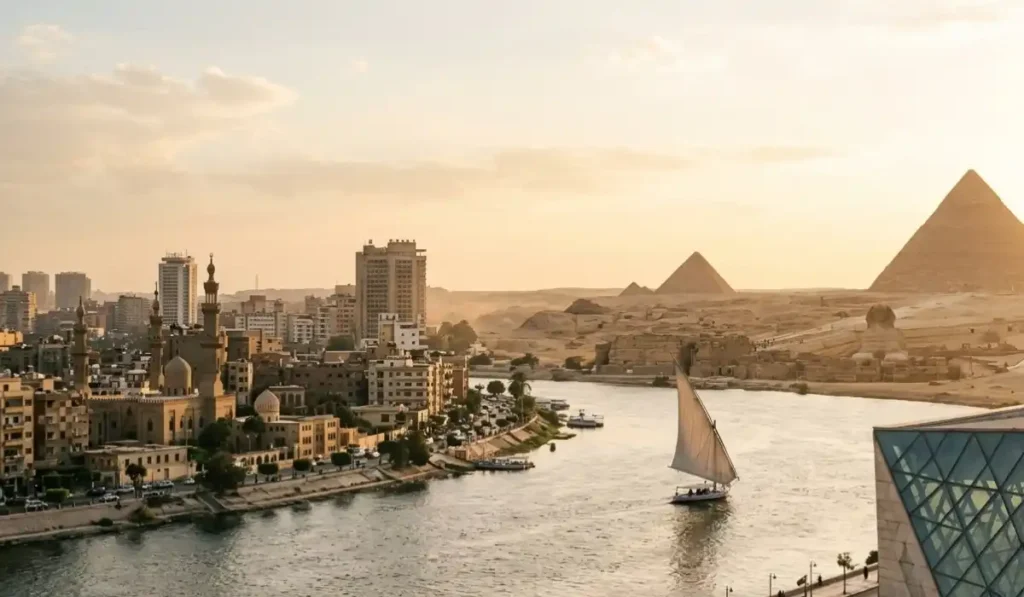
A traditional sailboat trip on the Nile is one of the simplest and cheapest things to do in Cairo, and one of the most memorable. Sunset is the best time to go, when the light hits the river and the city noise fades into the background.
Getting Around Cairo
Traffic is heavy and the road rules are more suggestion than law, so most visitors rely on ride-hailing apps or hotel-arranged drivers rather than self-driving. The Cairo Metro is fast and cheap for point-to-point trips but doesn’t cover every tourist site directly.
Distances between attractions look small on a map but can take much longer in practice, so build buffer time into your day rather than stacking sites too tightly.
When to Visit
October to April brings the most comfortable temperatures for walking around outdoor sites like Giza and the Citadel. Summer months regularly push past 40 degrees, which makes a big difference when you’re standing in an open plateau with no shade.
A Note on Safety
Cairo’s major tourist sites carry a visible security presence, including at the Pyramids, the Grand Egyptian Museum, and Khan el-Khalili. Current Australian government advice recommends a high degree of caution across Egypt generally, so it’s worth checking Smartraveller’s Egypt page before you travel, and registering your trip so you receive updates if anything changes.
Frequently Asked Questions
Q: How much does it cost to visit the Grand Egyptian Museum?
A: Foreign adult tickets are currently around EGP 1,450 to 1,500, roughly $28 to $30 AUD, booked online only.
Q: Do I need to book Grand Egyptian Museum tickets in advance?
A: Yes. Tickets are timed-entry and sold exclusively through the official website. There’s no on-site purchase option.
Q: How many days do you need in Cairo?
A: Three to four days covers the main sites at a reasonable pace, including a full day for Giza and the Grand Egyptian Museum together.
Q: Is Khan el-Khalili worth visiting?
A: Yes, particularly in the late afternoon or evening. It’s one of the oldest working markets in the world and a good spot for souvenirs and street food.
Q: What’s the best time of year to visit Cairo?
A: October to April, when daytime temperatures are far more manageable for sightseeing.