India does not have one cuisine. It has dozens, and they change every few hundred kilometres. The bread in Amritsar is not the bread in Chennai, and the fish curry in Kolkata has almost nothing in common with the one in Goa.
If you are visiting family, travelling for a festival, or passing through on a longer trip, it is worth eating deliberately rather than whatever is nearest. These are ten authentic Indian foods worth going out of your way for, where to find them at their best, and how to eat well without spending your holiday unwell.
Best single city for variety: Delhi, for north Indian and street food.
Best for seafood: Kolkata, Goa and the Kerala coast.
Best vegetarian spread: Rajasthan and the south.
Cheapest great meal: A street thali or a plate of chaat.
Golden rule: Eat where there is a queue of locals.
A fermented rice and lentil crepe, griddled until the edges shatter, wrapped around spiced potato and served with coconut chutney and sambar. It is breakfast across the south and a national obsession everywhere else.
Eat it in Bengaluru, Chennai or Mysuru, ideally at an old-school tiffin house before 10am when the batter is freshest. The Mysore masala dosa, smeared inside with red chilli chutney, is the version worth seeking out.
Rice and marinated meat cooked together in a sealed pot so the steam does the work. Done properly, every grain is separate and the meat falls apart. It is not the same dish as the biryani served in most Australian restaurants.
Hyderabad is the obvious place, and the dum style — sealed with dough and slow-cooked — is the one to order. Served with mirchi ka salan and a bowl of raita to cut the richness.
Biryani is a lunch dish in Hyderabad. Many of the best places sell out by mid-afternoon and will not cook a fresh batch for dinner. Go early rather than late.
Not one dish but a whole category of savoury snacks built on contrast — crunchy, soft, sour, sweet and hot in the same mouthful. Pani puri, bhel puri, dahi puri, aloo tikki, papdi chaat.
Delhi and Mumbai both claim it and both deliver. Pani puri is the gateway: a hollow crisp sphere filled with spiced water that you eat whole, in one go, immediately. Hesitate and it collapses.
Yes, you have had it at home. No, it is not the same. The original is less sweet, less heavy on cream, and built on tandoori chicken rather than plain poached meat.
Try it in Delhi, where it was created in the 1950s, and order it with naan rather than rice. While you are in the north, the dal makhani at the same table is usually just as good.
Mustard oil, mustard paste, green chilli and freshwater fish, most often hilsa or rohu. It is sharp, pungent and nothing like the coconut-based curries most visitors expect.
Kolkata is the place, ideally in a home or a small family-run eatery rather than a hotel restaurant. Shorshe ilish — hilsa in mustard — is the benchmark dish, though it is bony and takes practice. Our Kolkata travel guide covers more of the city.
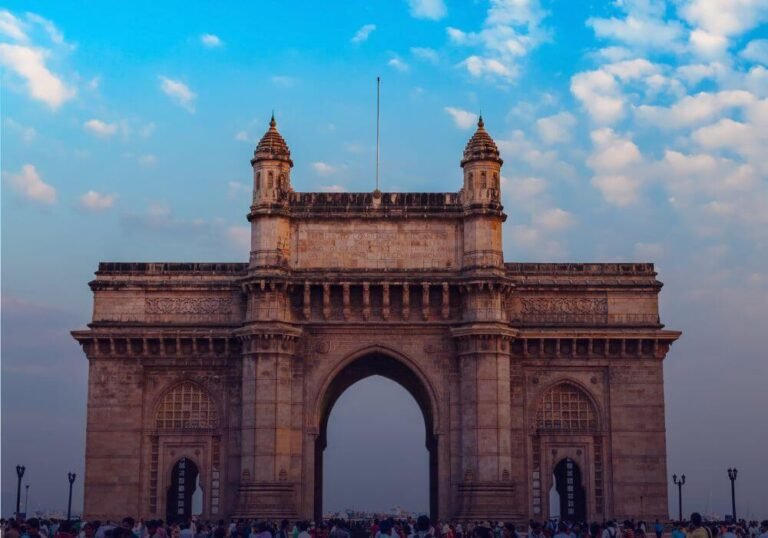
A spiced potato fritter in a soft bread roll with dry garlic chutney. It costs almost nothing and it is the thing Mumbai runs on.
Eat it standing up at a street stall in Mumbai, preferably near a railway station at peak hour where turnover is fastest. Ask for extra chutney and a fried green chilli on the side if you can handle it. There is more to eat in the city in our local guide to Mumbai.
A metal platter of many small bowls — dal, several vegetables, curd, pickle, chutney, breads and something sweet — refilled until you surrender. It is the most efficient way to taste a region in one sitting.
Jaipur, Udaipur or Jodhpur. Expect dal baati churma, gatte ki sabzi and ker sangri. Almost always vegetarian, and almost always more food than you expect.
At a traditional thali place, servers will keep refilling bowls without asking. Covering the bowl with your hand or a quick shake of the head is the polite way to stop a refill before you are beaten by it.
Lucknow’s contribution: meat minced to a paste, bound with ground spices, and cooked so gently it needs no teeth. The galouti kebab is the famous one, reputedly developed for a Nawab who had lost his.
Lucknow, in the old city, eaten with a sheermal or ultra-thin roomali roti. Nothing in the dish announces itself loudly — the spicing is deep rather than hot.
Spiced chickpeas with a deep-fried bread the size of a dinner plate, puffed up like a balloon. Punjabi, indulgent and completely unreasonable as a breakfast, which is exactly when it is eaten.
Delhi or Amritsar. Order one plate between two if it is your first time — the bhature are far bigger than they look in photos.
Indian sweets are their own universe: milk-based barfi and rasgulla, ghee-soaked halwa, syrup-soaked jalebi pulled hot from the pan. Falooda, a layered rose-and-vermicelli dessert drink, is the thing to order when it is too hot to eat.
Sweet shops everywhere, but Kolkata for Bengali milk sweets and Mumbai or Hyderabad for falooda. Buy mithai by weight, and buy less than you think — it is very rich.
Most visitors who get ill in India do so in the first few days, and usually from water rather than food.
If you have a serious allergy, be aware that cross-contact is common in small kitchens and that asafoetida (hing), used widely in Indian cooking, is often compounded with wheat flour. Carry a translation card in the local language stating your allergy clearly, and do not rely on English alone outside the metros.
A note for vegetarians: India is the easiest country in the world to eat vegetarian in. “Pure veg” signs mean exactly that, and vegetarian food is the default across much of the south and west. Vegans should still check — ghee, paneer and curd turn up in dishes that look plant-based.
Generally yes, if you choose well. Pick busy stalls with high turnover, eat food that is cooked hot in front of you, and be more cautious with water, ice and pre-cut fruit than with the food itself.
It depends what you want. Delhi has the broadest range of north Indian and street food, Kolkata is best for fish and sweets, Hyderabad for biryani, and the southern cities for dosa, idli and vegetarian cooking.
No. Much of it is aromatic rather than hot, and heat varies enormously by region. You can ask for less chilli, and curd, raita or lassi will take the edge off a dish that is too hot.
Very easily. Vegetarian food is mainstream rather than a special request, and "pure veg" restaurants serve no meat at all. Vegans should still ask about ghee, paneer and curd.
Some packaged items are allowed and many are not. Australia's biosecurity rules on meat, dairy, seeds and fresh produce are strict, so declare everything on your incoming passenger card and check the current rules before you pack.
Street food and local eateries cost very little, while hotel restaurants and fine dining in the metros can approach Australian prices. Most travellers find food is the smallest line in their budget.
Eat the regional dish in the region it comes from, go where the locals queue, and leave room — portions are generous and the best meals are often the cheapest. Check your India entry requirements before you fly, and if you are travelling for a festival, our guide to finding cheap flights for Raksha Bandhan covers the booking side.
Planning a trip around the food? Our consultants can build an itinerary across multiple Indian cities and compare flight deals to India for you — get in touch.

Oscar Mike writes about travel and tourism for Airways Travel, with a focus on the paperwork and planning that trips up Australian travellers heading overseas. His work covers entry requirements and visa rules, airline and airport policy, fare trends on the Australia–India and Australia–South Asia routes, and destination guides for families flying long-haul. He spends a lot of time reading government travel notices so you do not have to, and turns them into plain-English guides you can act on before you get to the check-in desk.
How to Find Cheap Flights to India for Raksha Bandhan (Last-Minute & Advance Hacks)

Things to Do in Mumbai: A Local Guide for Australian Travellers
Kolkata Travel Guide
Diwali 2026 Flight Deals: How to Score Cheap Flights from Australia to India
Air Suvidha Form 2.0: 2026 Travel Requirements for Passengers Flying to India
How to Score Last-Minute Cheap Flights to IndiaTell us where you are flying and our India specialists will come back with fares you will not find on a search engine.